
Maintaining Synthetic Turf Sports Surfaces for Long-Term Performance
Why Proper Maintenance Matters

Introduction
Synthetic turf sports surfaces provide durable, all‑weather playing areas that can sustain high levels of use. Manufacturers are constantly striving to improve the quality of its products, maximising the playing experience and extending the life of the surfaces. But the surfaces will only achieve their full potential and ensure a good return on your investment if they are adequately maintained.

Synthetic turf pitches play a huge role at all levels of football across Europe, whether it be in grassroots football, the amateur or the professional game. The development of synthetic turf playing surfaces has allowed players to enjoy the beautiful game in places where this had previously not been possible.
From the Nordic countries to the very south of Europe, climatic conditions can sometimes make the construction and maintenance of good quality natural turf fields next to impossible.
As the game has grown in popularity, including the great success stories around women’s football and soaring participation from young girls, there is even greater demand for more high-quality, safe playing surfaces that can deliver the amount of playing hours to meet this demand.
Synthetic turf football pitches play a large part in the work that UEFA has done to grow and develop the game across its 55-member national associations. As one of UEFA’s many development programmes, the HatTrick assistance scheme is responsible for funding the construction of over 1,000 pitches.
In recent seasons, both clubs and national associations in Nordic countries have achieved unprecedented success in international competitions, which can in part be attributed to the increased playing hours that synthetic turf has facilitated in these countries at times of the year when previously this had been unthinkable.
The work of the UEFA Foundation for children, which supports humanitarian projects promoting children’s rights through sport, often involves the construction of pitches, the majority of which are synthetic turf. To date, more than 155 pitches have been built or renovated across the globe as well as within Europe – mainly synthetic ones.
Player safety and playability are two key pillars of UEFA’s various pitch programmes, and the correct maintenance of synthetic turf is essential in achieving both these aims.
Synthetic turf fields also represent a significant financial investment for clubs and national associations, so the correct maintenance, planning and best practices are vital if a pitch is to remain playable for its entire life span, offering the full return on investment.
Historically, the misconception that synthetic turf fields, once installed, require little to no maintenance has resulted in pitches deteriorating well before their potential end of life. The purpose of this document is to share the key principles, techniques and best practices in the maintenance of synthetic turf pitches, in order that these facilities continue to provide safe, high-quality spaces for football to be played by as many people as possible.
UEFA Pitch Management Expert
Types of Synthetic Turf
Synthetic turf systems vary by pile height, infill content and intended sport use. Surfaces are often classified as being long pile turfs (typically more than 30 mm) and short pile turfs. Both types may contain a significant depth of infill, be lightly dressed with an infill or not have any infill (non-filled).
An increasingly large range of infill materials are now being used; each of these is likely to require slightly different maintenance so it is very important that you turf supplier provides comprehensive instructions for the materials they are supplying.
While this guideline focuses on long pile turfs (commonly used for football and rugby), many of the general maintenance principles also apply to other synthetic turf sports surfaces.
The manufacturer of your synthetic turf surface is best placed to provide specific guidance on how their product should be maintained; but this guide outlines the main principles of what is required and how frequently the various maintenance operation need to be undertaken.
Why is the maintenance of a synthetic turf surface so important?
Maintaining your synthetic turf sports field is essential for safety, performance, longevity, and sustainability. Here’s why it matters:
Player safety: synthetic turf is designed to ensure athletes are protected from injuries when they run, twist, turn, slide and fall on the surface. If the surface is not maintained correctly the ability of the surface to protect the athletes is reduced.
Optimal sports performance: ensuring the way a ball interacts with the playing surface is key to providing a field that allows players to perform to their full potential, meaning they have an enjoyable and positive playing experience.
Cost efficiency: a new synthetic turf sports field is a major investment. For a newbuild facility, much of the overall cost is associated with the groundworks, base, drainage system, perimeter fencing, and floodlighting, while typically 20–25% of the total cost relates to the synthetic turf carpet, infill, and shockpad underlayer. The usable life of a synthetic turf surface will depend on many factors, including location (amount of harmful UV radiation), intensity and type of use and amount of maintenance undertaken. Typically, a surface will perform adequately for between eight and twelve years, with many advocating replacement or sinking funds be based on a 10-year period.
Resurfacing a field will also incur significant costs that include lifting and disposal of the old turf and the cost of the new surface. Based on 2026 resurfacing costs of €300,000 and an annual interest rate of 3% means that replacing a synthetic turf surface after seven years will require a yearly sum of €39,000 to be set aside, whereas extending the life of the playing surface to twelve years reduces this annual contribution to €21,000 per year. Maximising the life of the playing surface through good maintenance is therefore key to the financial sustainability of a facility.
Environmental protection: synthetic turf surfaces are based on man-made materials that will weaken and degrade over time and through use. Planned maintenance, using the right equipment, will ensure that fibre and infill debris does not become a source of environmental pollution.
Warranty protection: your new synthetic turf surface will be covered by a warranty, which will be conditional on the surface being maintained in accordance with the manufacturer’s instructions. In the unfortunate situation of a warranty claim being made, the manufacturer is likely to ask for proof that the field has been maintained correctly for the levels of use it has been subjected to.
Field certification: regular and appropriate maintenance is an essential part of ensuring a field retains the necessary performance that is required by field certification programmes, such as those operated by FIFA, FIH and World Rugby.

- Explains how long pile synthetic turf degrades over time
- Identifies mechanisms of degradation
- Quantifies the effects of different maintenance interventions
- Links degradation and maintenance directly to changes in surface performance and safety
- Grooming – Redistribution of infill and fibre realignment
- Cleaning – Removal of fine contaminants that affect infill mobility
- Decompaction – Mechanical loosening of compacted infill
- Infill top ups – Replacement of lost rubber infill to restore depth
The importance of maintaining your surface to minimise the impact on the environment
Synthetic turf surfaces bring many benefits but like many man-made products they need to be maintained to ensure they do not degrade and adversely affect the environment. Fitting containment boards to perimeter fencing and catchment grates at entrance gates can significantly reduce the possibilities of materials escaping into the environment, but good surface maintenance is also needed.
Preventing infill migration
Irrespective of their type, if infill materials are allowed to leave a field, they can contaminate the surrounding ground. Studies have shown that one of the biggest sources of infill transportation from a sports field into the environment is maintenance equipment. Ideally, the equipment store should be adjacent to the sports field, meaning the equipment never has to leave the confines of the field. Unfortunately, this is not always possible, in such cases it is very important that the maintenance equipment is cleaned (e.g. using compressed air) to remove any infill or fibre debris before it leaves the field.
Collecting fibre debris
Like any plastic product, the yarns used to form a synthetic turf will weaken due to exposure to sun light and the mechanical stresses caused by use. Over time, the strength of the yarns will deteriorate to a point where they start to fracture, and small pieces break away from the pile of the turf carpet. These small shards of yarn can become a source of pollution, if not collected, and are carried off the sports area into the surrounding environment.
Studies have shown that fibre wear will typically start to occur when surfaces reach approximately half their lifespan, which is usually after five or six years of use. The studies have also shown that the fibre wear does not occur uniformly across a field or court but tends to primarily occur in areas subjected to highest use. These include the goals mouths and base lines on tennis courts, etc.
Generally, it will become obvious to anyone using or walking on a field or court when the yarns are breaking, as the broken off fibre strands will stick to their shoes and clothing. If a more objective approach is required, pulling a metal straightedge over the surface will allow you to see if any fibre debris sticks to it. If they do you need to address the problem.
Once it is identified that the yarns are weakening and starting to fail, it is very important that you introduce an appropriate maintenance regime that will collect the debris and prevent it from escaping into the environment.
But what does this mean?
Simply put, the surface needs to be maintained using specialist equipment that can brush the surface and lift any debris, including fibres, from the surface to allow responsible disposal.
Typically, these machines will separate any debris they lift into three components:
⦁ Using sieves, larger debris (leaves, boot studs, bottle tops, etc.) are separated and collected for disposal.
⦁ Any infill that has also been lifted from the surface is then allowed to drop back onto the turf and is brushed back into the surface.
⦁ At the same time, cyclone and filter technology (or similar) is used to separate any small, lightweight debris (including fibre debris) so that it can also be collected and disposed of responsibly.
How frequently do I need to do this?
This will be very dependent on the age of the surface, how intensively it is used, and its geographic location. Maintenance always works best as cumulative approach and innovations in machinery technology mean many operations can completed throughout the year, but experience has shown that deep cleaning to collect fibre debris is most effective when the surface is dry.
⦁ Experience has shown that fibre debris is best collected when the turf is dry enabling the brushes to be set deeper into the surface, this is recommended to be undertaken at least once annually as part of a deep clean.
⦁ Maintenance always works best as cumulative approach and with innovations in machinery technology and the available filters means that Power Sweeping can be completed throughout the year, helping to regulate the levels all year round.
Maintenance procedures commonly undertaken on synthetic turf surfacing containing infill
Generally, a maintenance programme for filled surfaces will comprise:
Daily / Weekly Tasks
Visual checks
- Check for litter, debris, and foreign objects.
- Inspect seams, inlaid lines and the general surface for failures and damage, repair any failures as soon as possible so they do not become more serious.
- Check the infill levels of penalty spots (and short corners on sand dressed hockey fields) and general high wear areas. Replenish infill to any areas where the infill has been displaced through use, to protect the turf pile to avoid damage.
- Check the surface for signs of contamination, typically from users’ footwear, animal and bird excrement and external factors such as washdown from surrounding areas.
- Inspect entranceway decontamination areas to ensure that the grating or matting is clean and boot brushes are fully functional.
Brushing: use a suitable brushing unit to lift the turf pile. To prevent the development of pile directional leaning, it is important the brushing follows an organized driving-plan, so operatives do not always drive around the field on the same route.Ssee Procedures for turf containing infill for suggested driving-plan, see diagram below…
Vertical Brushing
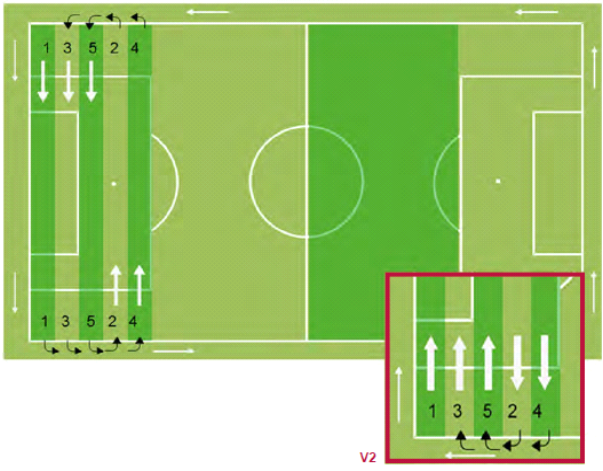
Horizontal Brushing

Diagonal Brushing

Spot Cleaning: remove any debris such as litter, chewing gum, animal excrement, leaves, weed growth etc. Clean-up any spillages (drinks, bodily fluids, etc). Remove any stains.
Algae/moss/ weed growth: inspect shaded/damp zones and field perimeters; if algae, moss is present, treat in accordance with manufacturer guidance and local regulations. If weeds are present remove before they become established.
Monthly Tasks
Infill level check: measure infill depths, particularly in the high use areas e.g. penalty spots, centre spots, corners and goal mouths, and top up where necessary using an in-house stock of infill.
Power Sweeping: this is a cumulative process and should be completed at regular intervals throughout the year. This process is more technical than Drag Brushing and is undertaken using specialist maintenance equipment designed to extract contamination from the infill, while returning usable infill material back to the surface.
The frequency of specialist Power Sweeping is dictated by the levels of usage, environmental factors, and the performance standards. Recommendations will vary from manufacturer to manufacturer; however, the industry norm is typically for a minimum of bi-monthly visits, but many high-performance facilities regularly opt to undertake this process monthly.
Infill decompaction: decompact the infill using specialist rakes / tines to restore the surface’s performance feel underfoot.
Note: Infill decompaction should be undertaken following power sweeping to avoid turning over contaminated infill and forcing the contaminants deeper into the pile of the carpet.
Environmental contamination: Inspect the external surrounds of the field and remove any infill or fibre debris that has been carried or blown off the field and dispose of responsibly.
Surface water drainage system check: Ensure drains and channels are clear of blockages.
Annual / Six Monthly Tasks
Deep Cleaning: deep cleaning is typically undertaken using specialist maintenance equipment designed to extract contamination from the infill, while returning usable infill material back to the surface. A deep cleaning process should be undertaken using equipment that includes a controlled working depth and a screening mechanism to separate infill material from contaminants. The equipment should ideally incorporate a vacuum and filtration systems for extracting fine dust, contaminants and fibre debris, so they are not flushed into storm water sewers, etc.
When specialist deep cleaning equipment is not available, surface contamination can be reduced using a ground-driven rotary brush system, followed by infill decompaction using metal tines with a final thorough grooming pass to restore fibre orientation and achieve a consistent surface finish.
Deep cleaning is most effective when undertaken in drier weather conditions, typically in the Spring, Summer and Autumn months.
Annual Field Certification Preparation
If your field is tested periodically to allow certification by international or national sports federations, preparatory maintenance before the test is recommended. This will include:
- Infill top-up and regrading
- Power sweeping to ensure the turf pile is standing upright
- Inspection and repair of all turf and in-laid line joints
- Repair of any turf tears, damage etc
- Checks to ensure goals, perimeter fencing etc are in good repair
Rubber vs Plant Based Infills
The principles of maintaining synthetic turf surfaces that contain plant based (vegetal) infills, mineral(sand) infills and polymeric (rubber) infills are the same, but it should be remembered that:
- Plant based infills are often lighter and more prone to migration through wind erosion and floating in heavy rain. Whilst all fields will lose material and required periodic topping up, the frequency for surfaces with plant based infills is often a higher and the quantity of additional material greater.
- Plant based and mineral infills are often more likely to compact through use, meaning that the frequency of raking with metal tines to decompact needs to be increased compared to rubber filled surfaces. Failure to decompact may result in a loss of sports performance and a greater potential for surfaces to not drain adequately and become waterlogged.
Generally, experience to date is suggesting that the maintenance needs of surfaces with plant based infills is greater than those with rubber infill materials. Whilst climate, location and intensity of use will all have a major impact on the costs of maintaining a sports field, field owners should ensure their maintenance programme and budget is appropriate for the type of infill they have.
What are the maintenance procedures commonly undertaken on non-filled synthetic turf surfaces
Generally, a maintenance programme for non-infilled surfaces will comprise:
Daily / Weekly Tasks
- Checks & inspections
- Check for litter, debris, and foreign objects.
- Inspect seams, inlaid lines and the general surface for failures and damage, repair any failures as soon as possible so they do not become more serious.
- Check the surface for signs of contamination, typically from users’ footwear, animal and bird excrement and external factors such as washdown from surrounding areas.
Brushing: use a suitable brushing unit to lift the turf pile. To prevent the development of pile directional leaning, it is important the brushing follows an organized driving-plan, so operatives do not always drive around the field on the same route.
See Procedures for turf containing infill for suggested driving-plan.
Note: Short pile non-filled turfs are normally only brushed along the length of the turf roll (vertical brushing).
Spot Cleaning: remove any debris such as litter, chewing gum, animal excrement, leaves, weed growth etc. Clean-up any spillages (drinks, bodily fluids, etc). Remove any stains
Algae/moss/ weed growth: inspect shaded/damp zones and field perimeters; if algae, moss is present, treat in accordance with manufacturer guidance and local regulations. If weeds are present remove before they become established
Monthly Tasks
Surface water drainage system checks: ensure drains and channels are clear of blockages.
Annual / Six Monthly Tasks
High pressure water cleaning is undertaken using specialist maintenance equipment designed to flush out contamination from the turf. The equipment should ideally incorporate a filtration system to capture fine dust and fibre debris so they are not flushed into storm water sewers, etc.
Annual field certification preparation
If your field is tested periodically to allow certification by international or national sports federations, preparatory maintenance before the test is recommended. This will include:
- Power sweeping to ensure the turf pile is standing upright
- Inspection and repair of all turf and in-laid line joints
- Repair of any turf tears, damage etc
- Checks to ensure goals, perimeter fencing etc are in good repair
What types of maintenance equipment are commonly used?
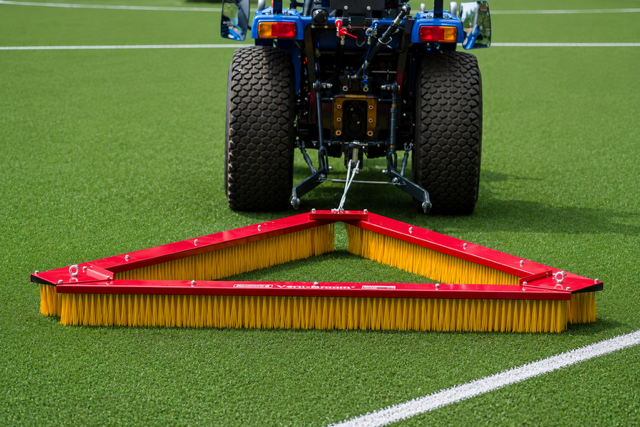
A basic piece of maintenance equipment, comprising a drag brush that attaches to a mini-tractor, all terrain vehicle (ATV), or similar towing equipment. The brush typically consists of three brooms with plastic bristles arranged in a triangular configuration, but other units with integrated brushes can be used. These:
- Straighten turf fibres so they stand upright.
- Redistribute infill evenly across the surface.
- Support routine grooming to maintain a consistent and even playing surface.
A triangular drag brush is not designed to remove coarse contamination such as leaves or debris. These should be removed using dedicated collection methods (ground driven rotary brush systems or specialist extraction equipment). If you try to use a triangular brush to remove coarse material it is more likely to break the materials down into finer particles that will then work into the turf carpet and infill layer, restricting drainage and making the surface feel firmer.

A flexible mat made from durable moulded rubber, often reinforced with a steel or galvanised frame for strength. It is designed to be towed behind a tractor, ATV, or similar vehicle. A drag mat helps:
- Maintain a consistent, level playing surface by smoothing out infill and distributing it evenly across the field or court, maintaining performance.
- Improves the field or court’s appearance.
A drag mat should be used with caution on long-pile turfs as it can flatten the pile. Following drag matting a field normally requires brushing to lift the pile.

Sometimes called a ground driven rotary brush system. These rotate at ground level, lifting the synthetic turf fibres upright. This helps counteract matting caused by heavy use and weather. Unlike drag brushes (which are mainly for grooming), rotary brushes can remove coarse and embedded contamination, such as:
- Leaves
- Small debris
- Broken fibre fragments
- Compacted organic matter
Studies have shown that use of a rotary brush is often far more effective than using a triangular brush.
Rotary brushes are also often used before decompaction or deep cleaning to expose compacted layers and release embedded debris.
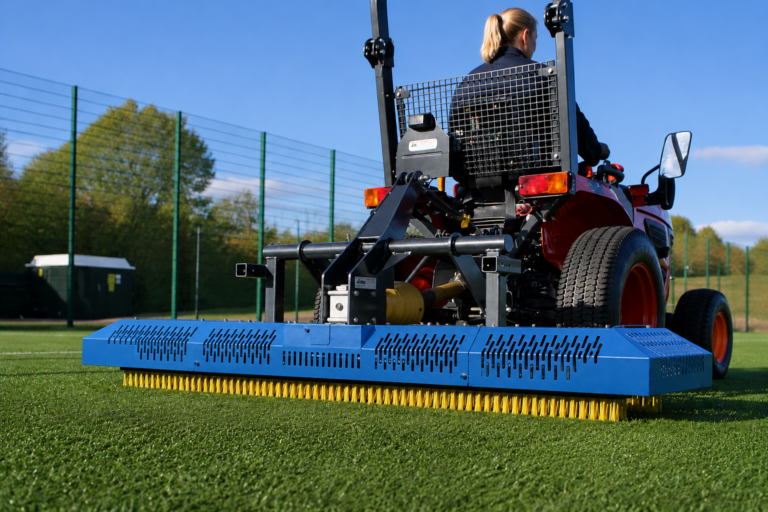
An alternative to a rotary brush, this is an advanced grooming brush that moves laterally side to side, restoring the pile fibres to a more upright position, improving appearance and playing performance. For surfaces containing infill, the brush movement also relieves surface compaction, redistributes the infill and helps smooth out minor surface irregularities. Oscillating brushes do not have the means to pick-up and collect surfaces, debris.
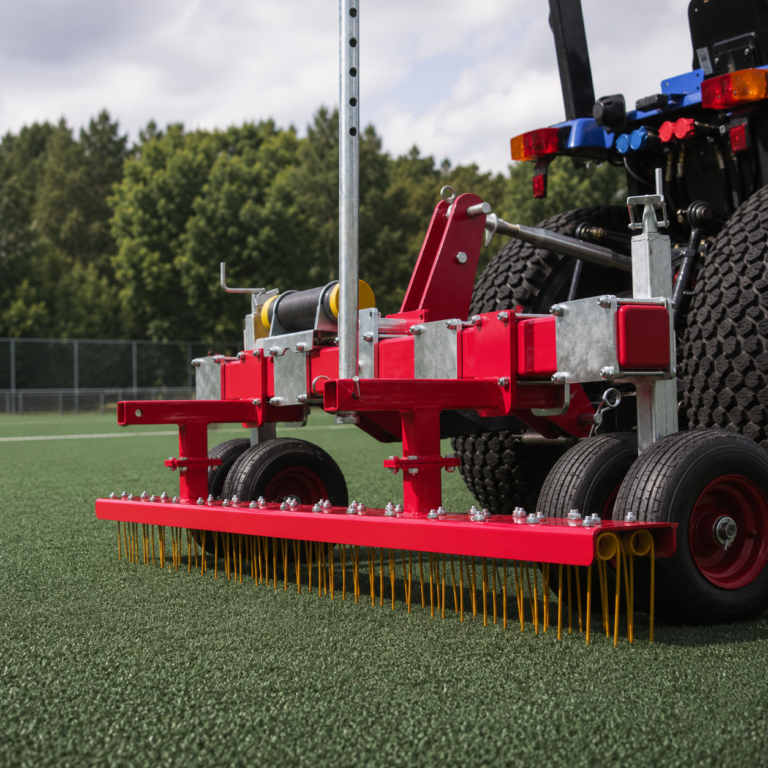
All infill materials will compact through use, rainfall and surface contamination. Relieving this compaction is extremely important if you wish to retain good performance, player comfort, and surface drainage.
Decompaction is undertaken using specialist equipment that loosens the infill. The equipment may be based on rotating or static tines that are pulled through the infill layer to loosen the infill. Due to the invasive action of the tines and the risk of damage to the synthetic turf carpet, decompaction needs to be undertaken by skilled operatives.

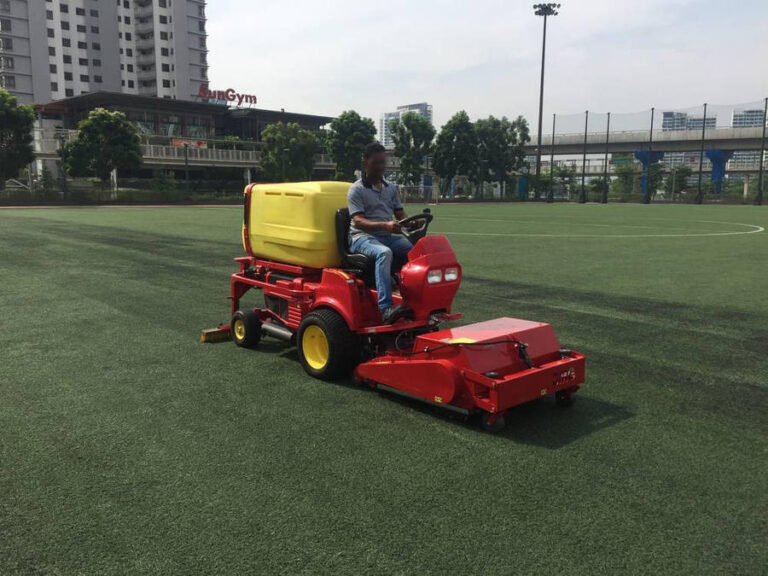
Specialised equipment designed to extract contaminants, including fibre and infill debris, that are unreachable with surface-level equipment. Using a combination of rotating brushing, high pressure suction and filtration the contaminants are extracted for disposal, whilst the clean infill is returned to the turf surface.
With an ever growing focus on minimising environmental pollution it is important that deep cleaning machines are able to pickup and capture fibre and rubber infill debris, so it does not become a microplastic pollutant. Of biggest concern to environmentalists are the small particles that can most readily get into the marine environment and food chain. It is therefore recommended that whatever deep cleaning machine you use, it should be fitted with a filter that will capture fine particles (e.g. Class PM1 80% as described in European Standard ISO EN 16890).

Ride-on cleaning systems for non-filled synthetic turf surfaces that uses high-pressure water cleaning with integrated recovery. Designed to remove contaminates and algae, cleaning is carried out using rotating, angled nozzles with an adjustable water pressure, ensuring uniform and gentle deep cleaning. Ideally, the equipment should have a turbine-based suction system that removes wastewater, organic contamination and fibre debris (microplastics).
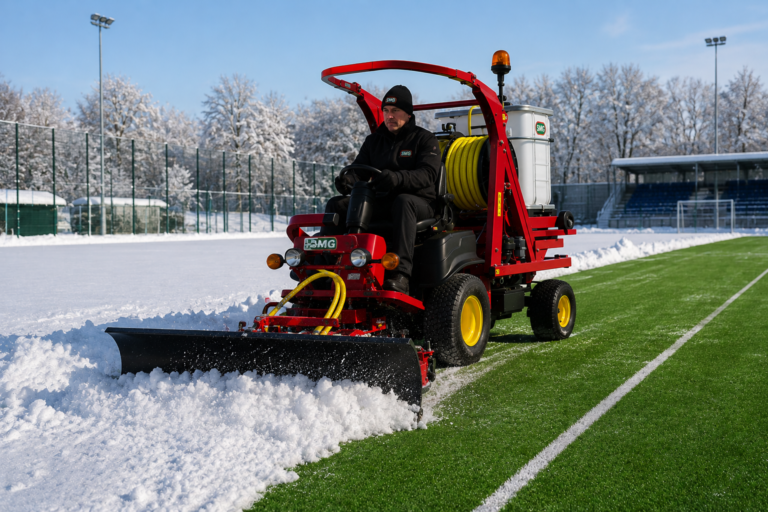
Snow should be removed from a synthetic turf field using only lightweight, non‑metal equipment that protects the fibres and infill. Fresh, dry snow can be cleared with soft brushes, rubber‑edged ploughs, or walk‑behind sweepers, working in straight passes to avoid disturbing the surface. For deeper or compacted snow, use a rubber-bladed tractor attachment set high enough to avoid contact with the carpet, followed by a rotary brush to lift remaining snow without extracting infill. Never use metal shovels, salt, or de‑icing chemicals, as these can damage fibres, backing, and drainage performance. Once cleared, allow the field to air‑dry naturally before resuming play to prevent compaction or freezing of the infill.

A sprayer system used to apply approved chemicals (e.g. herbicides and algaecides,) to targeted areas of the pitch. These control biological growth such as algae and weeds in shaded or damp areas, preserving surface playability and aesthetics.
Frequency of Maintenance
Precise instructions on how to maintain your sports field should be provided by the manufacturer of the synthetic turf surface when the surface is installed and handed over for us. These instructions should always be followed.
The frequency of these tasks will be totally dependent on the amount of use your field receives. Use is a combination of:
- Playing hours
- Number of players per session
- Activities undertaken
- Types of footwear being worn
- Size of the area (full size pitches or mini-pitch, etc)
It is not uncommon for a maintenance schedule to be introduced when a new field first opens for use. As the popularity of the field grows and use increases the maintenance schedules and frequency needs to be adjusted to reflect this. The more people using the field, the greater the maintenance needs.
As a very general rule of thumb many advocate ten hours use by 22 players will require one hours weekly brushing, etc. Doubling the use through cross-pitch play (e.g. simultaneously hosting 2 games of 9 v 9 football) my mean that weekly maintenance needs to be increased and becomes twice-weekly maintenance, etc.
Manually monitoring usage is often challenging and often does not provide enough information to ensure the correct frequency of maintenance is undertaken. Increasingly, people are finding the use of 24/7 AI camera technology simplifies this process allowing real-time data to be accessed whenever needed.
Many of the maintenance procedures required are more effective when they are undertaken when the synthetic turf surface is dry. This is often not possible in many countries, especially when the fields are used in wetter periods of a year. This does mean that enhanced maintenance frequencies may be required to compensate for the difficulties of trying to maintain wet turf and infill.
Who should maintain your field?
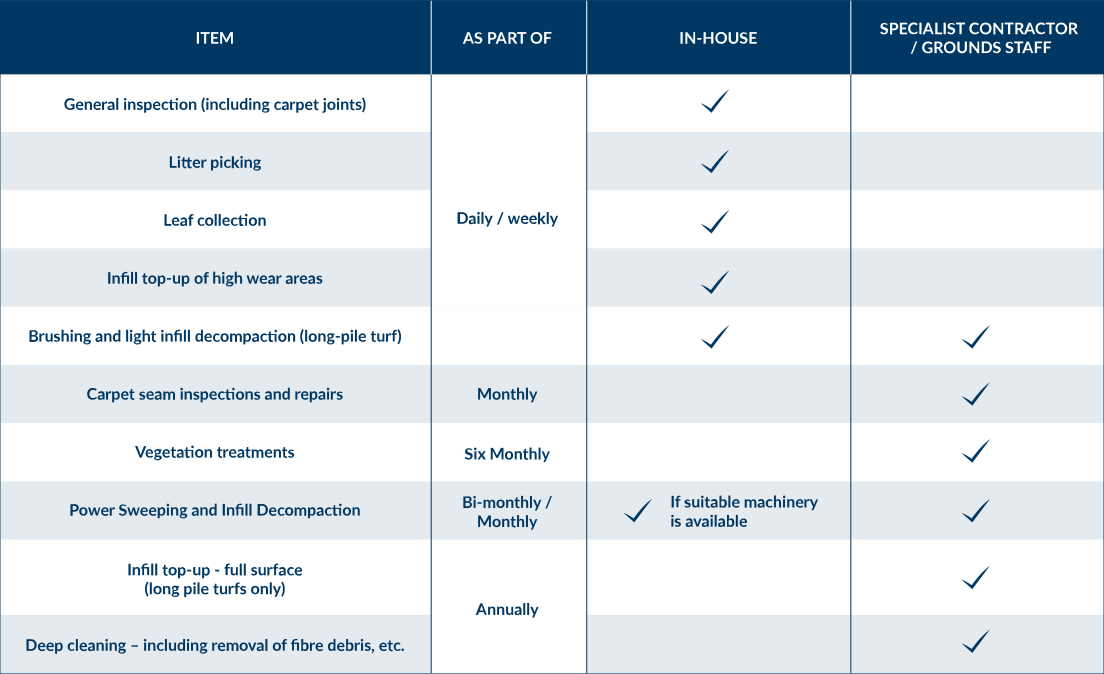
Maintenance can be undertaken in-house using trained staff or by specialist maintenance contractors. Typically, weekly maintenance is undertaken in-house whilst periodic maintenance programmes are undertaken externally, using specialist equipment. Irrespective of who is maintaining the field it is very important that they are suitably trained.
- The maintenance operatives need to appreciate the key role they play in ensuring the longevity, safety, and performance of the field or court.
- Refresher training helps to ensure that maintenance practices are completed in line with current guidance and best practices to limit environmental impact and encourage responsible management of waste materials.
References
Fleming P R, Watts C, Forrester S. A new model of third generation artificial turf degradation, maintenance interventions and benefits.Proceedings of the Institution of Mechanical Engineers, Part P: Journal of Sports Engineering and Technology. 2023;237(1):19-33. doi:10.1177/1754337120961602 (OPEN ACCESS)
Alternative Infills And Maintenance of Synthetic Turf; Strunk D; Western Kentucky University
ISO EN 16890 Air filters for general ventilation — Part 1: Technical specifications, requirements and classification system based upon particulate matter efficiency (ePM)
Acknowledgements
The ESTC Maintenance guidance has been prepared by the ESTC Synthetic Turf Maintenance Task Group comprising:
- Tobias and Daniel Owegeser, SMG Sportplatzmaschinenbau GmbH
- Tom Nott, Technical Surfaces Ltd
- Professor Dr Paul Fleming, Loughborough University
- Lee Guerriero, UEFA
- Alastair Cox, ESTC