
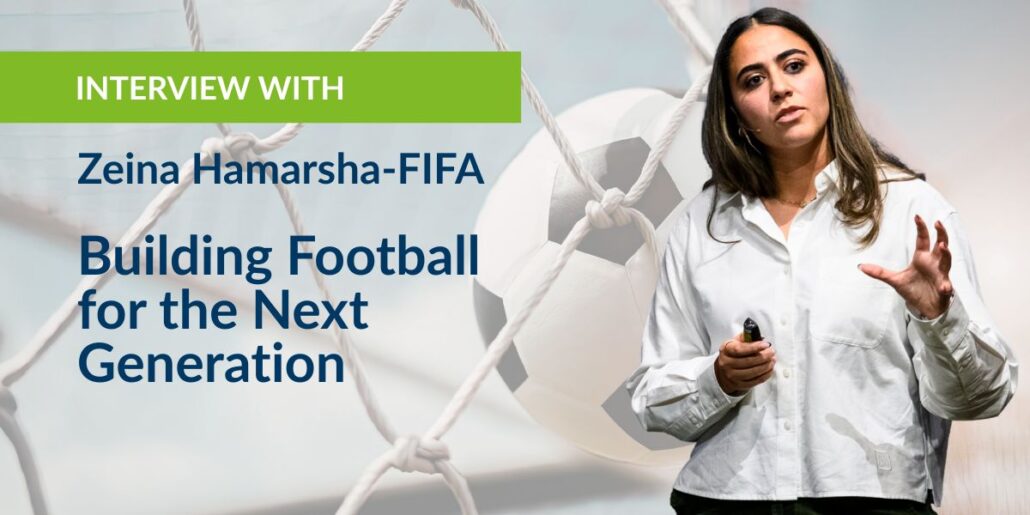
From defending the goalposts for Jordan women’s national football team to advancing football infrastructure at FIFA, Zeina Hamarsha has built a career that combines elite sport, engineering and innovation. Today, she plays a key role in FIFA’s Quality Programme, helping develop standards and technologies that improve the safety, performance and sustainability of football surfaces worldwide.
As part of its collaboration with ESTC, FIFA works closely with industry experts to advance quality standards, innovation and sustainability in football turf systems. In this interview, Zeina shares insights into her journey, the role of technology in football, and how cooperation between FIFA and ESTC is supporting the future development of the game.
- Can you describe your journey from being a goalkeeper for Jordan’s Women’s National Football Team to becoming a civil engineer and then transitioning back into the managerial side of sports?
Balancing football alongside my academic studies posed significant challenges. Joining Jordan’s national team at the age of 16 required a lot of time management as I was committed to trainings with my studies. However, the challenge became harder during university when I was studying civil engineering due to the extended team camps, leading to the tough decision of prioritizing my education over football in 2014. Yet, a great opportunity came up when I was invited to be part of the organization of the FIFA U17 Women’s World Cup Jordan 2016, revealing the broader dimensions of the sport. Following graduation I’ve worked in bridges and port structural design but I realised that my everyday life cannot exist without football. This passion for football led me to pursue my education further in sports management by studying the FIFA Master program and getting the opportunity to join FIFA in 2021.
- Can you elaborate on your role within the FIFA Innovation division at FIFA? What are some of the key projects or initiatives you’ve been involved in?
For the past two years, I’ve been managing the infrastructure area of the FIFA Quality Programmes within the , which covers a broad range of products and systems including artificial turf, natural playing surfaces, futsal courts, floodlights, footballs and football goals.
My role focuses on certifying these technologies and developing the standards that guide them. This work is carried out in close collaboration with our technical advisory groups and specialised working groups—bringing together FIFA Preferred Providers, FIFA Licensees, manufacturers, FIFA Research Institutes, test institutes, and universities. These expert groups help us address key technical topics and ensure continuous improvement across all programme areas.
Our goal is to make sure that every system and product used in the game is safe, durable and high‑performing. To support this, we also monitor the consistency and quality of testing worldwide. Each year, we organise dedicated test events to evaluate the performance of our accredited test institutes. Most recently, our infrastructure test events and Technical Advisory Group meetings took place in Rabat, Morocco. This event not only demonstrated the global reach of our work but also highlighted our growing focus on the different regions each year.
- In what ways do you believe technology can enhance the accessibility and sustainability of football, especially for women?
In Jordan, were I used to play most of my time, Football turf pitches are highly used due to the fact that the country has a limited water resource thus limiting the availability of natural turf pitches. This type of technology gives more accessibility to the game in countries that have environmental challenges.
As a player I believe technology should consider all categories and all levels of the football game and should be developed based on data evidences. The inclusion of women players is essential in research especially with the rapid increase of the women’s game. During my times, I wish I had tailored trainings from the data collected with EPTS devices on my performance. In this way I could focus on overcoming my weakness and enhance my performance using this data evidence rather than what the coach feels like doing for the whole team together because in the end it affects the whole training and the team. On a good note, we now see more tailored training with companies that are doing these types of research and data collection.
Regarding sustainability, a key aspect involves recycling and reducing resource consumption, in particular freshwater.
- How do you value the relationship between FIFA and ESTC relative to the future of football turf?
It’s a very important relationship were knowledge is being exchanged between expertise in this field. It gives us a wider aspect of other uses of synthetic turf that can potentially be of use on our surfaces. It’s a great platform were we work together on finding solutions to issues within sustainability and best practises.
The relationship with the industry for all FIFA Quality programmes is a key element that allows us to develop and shape technologies for the specific needs of football, from grassroots to elite levels. FIFA is keen to engage with industry bodies like ESTC that are genuinely motivated in pursuing quality standards and supporting the development of the game.