
Stronger Together
Taking on the role of interim Chair of the ESTC comes at an important time for our industry. It is also a responsibility that I take seriously.
A trade body exists for a simple reason: we are stronger together than we are individually. The ESTC should provide our industry with a collective voice, a place to share knowledge and experience, and a platform from which we can engage constructively with customers, regulators, policymakers and other stakeholders.
That does not mean that we will always agree. Indeed, a healthy trade association should be capable of accommodating different commercial interests and different perspectives. What matters is that we have the confidence to discuss difficult issues openly, respectfully and with the long-term interests of the industry in mind.
Working through the challenges
Our sector continues to face significant challenges. One of the most visible is the move away from rubber crumb and towards alternative infill solutions. This transition brings technical, environmental and commercial questions, and there is no single answer that will suit every application or every market.
As an industry, however, we have an opportunity to work together to improve standards, share evidence and develop solutions that meet changing expectations. The ESTC can play an important role in ensuring that these discussions are informed by facts and practical experience rather than by competing claims or short-term interests.
Commercial realities
We should also recognise the commercial pressures facing our members. The synthetic turf market is changing, with consolidation taking place across different parts of the supply chain. Businesses are competing hard for customers and market share, and that competition is entirely legitimate.
But commercial success and responsible behaviour should not be seen as opposing principles.
Ethics and commerce are connected. The reputation of one company, one product or one project can affect perceptions of the wider industry. Equally, a trade body cannot ignore legitimate commercial concerns when considering how the sector should operate.
Our responsibility is to provide a framework in which those interests can be discussed fairly, while maintaining clear principles around transparency, integrity and responsible conduct.
Our legacy
We should also think carefully about the legacy we are creating.
The industry has made enormous progress in the quality and performance of synthetic turf, but we should not ignore the legacy of poorly designed, poorly installed or poorly maintained pitches. When a customer has a bad experience, they do not necessarily distinguish between one supplier and another. Their experience can influence their view of the entire sector.
That makes quality more than an individual commercial issue. It is an industry issue.
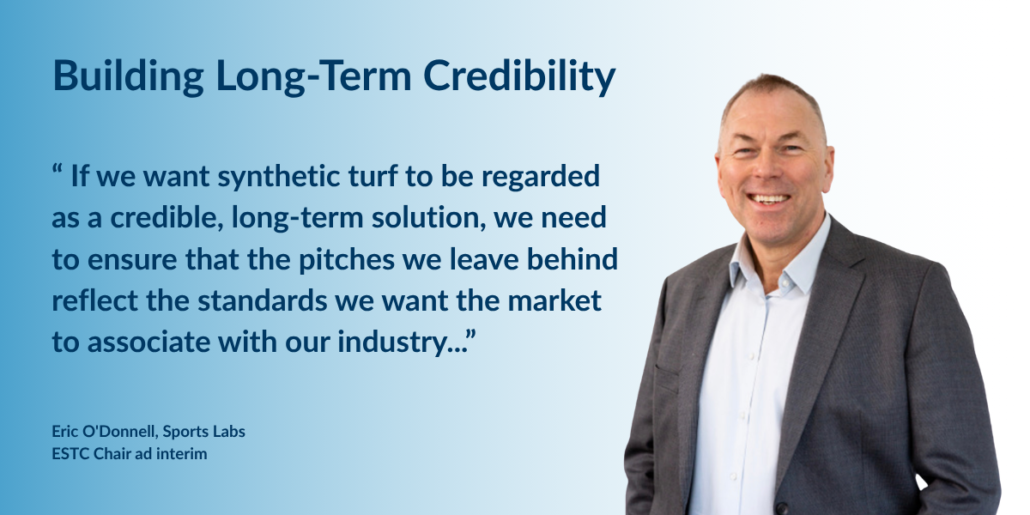
If we want synthetic turf to be regarded as a credible, long-term solution, we need to ensure that the pitches we leave behind reflect the standards we want the market to associate with our industry.
Regulation
Regulation is another area where collective representation matters.
The experience of the past demonstrated how quickly external pressures can disrupt established assumptions and how important it is for our industry to understand and respond to regulatory developments collectively. Regulation can sometimes feel like something being done to our industry, but the better approach is to engage early, provide evidence and make sure the realities of our businesses and our products are understood. The EsTC is a credible voice in that conversation.
Looking forward
As interim Chair, my ambition is not to suggest that we have all the answers. It is to help create an environment in which the ESTC can have the difficult conversations, represent the industry with credibility and help our members navigate the changes ahead.
A strong trade body should be prepared to challenge as well as support. It should protect the legitimate interests of its members while recognising its wider responsibility to the industry and the people who ultimately use the products and facilities we provide.
There will inevitably be differences of opinion. That is not a weakness. If we can debate those differences constructively, honestly and respectfully, they can make the industry stronger.
We have much to gain by working together, and much to lose if we allow individual differences to become more important than the future of the sector as a whole.
That, for me, is what “Stronger Together” should mean—and it is the principle I hope will guide the ESTC in the months ahead.
Eric O’Donnell, Sports Labs
ESTC Chair ad interim