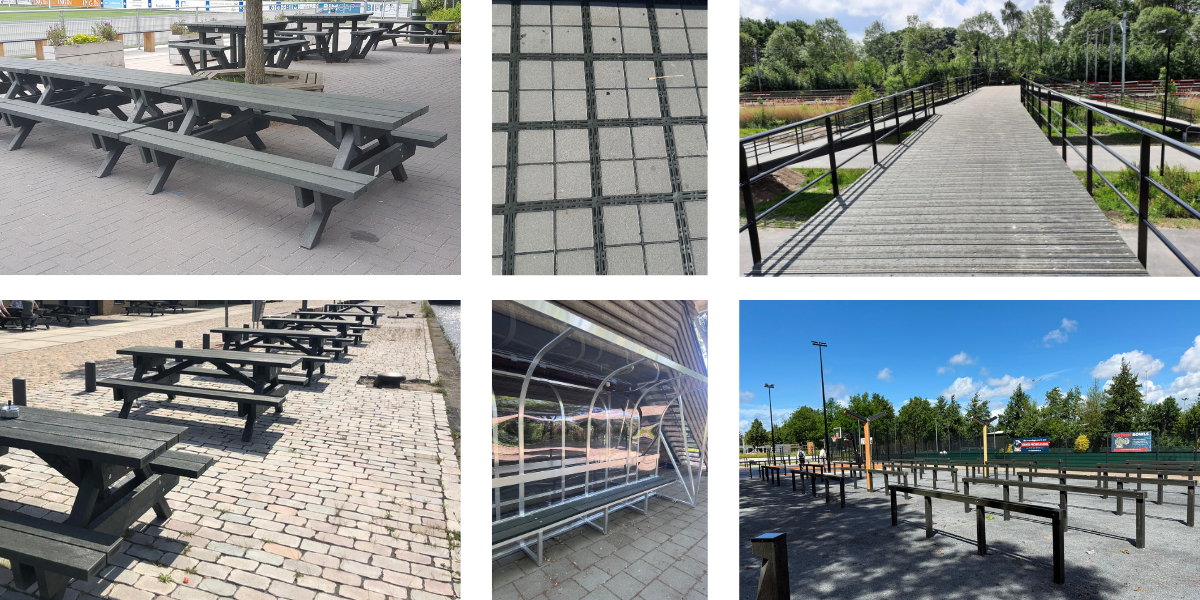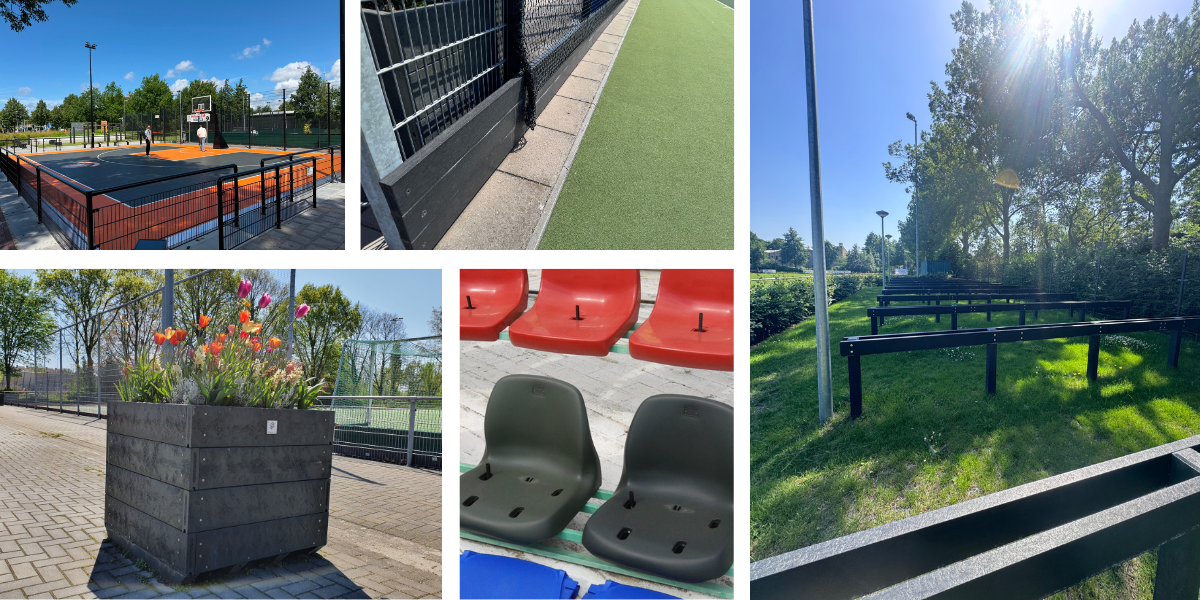
An ever-growing portfolio with products made of recycled synthetic turf is enabling municipalities and facilities managers to become truly circular. These products have been designed to last but can also be recycled for another good use. Best of all is that they correct a historic problem.
While the synthetic turf industry is edging closer to 100% cradle-to-cradle turf by the day, the sector is currently dealing with the issue of reclaimed synthetic turf carpets that were designed and produced before the design-to-recycle approach became the norm. Companies like ESTC members GBN Artificial Grass Recycling (GBN-AGR) in the Netherlands and FormaTurf in Germany are now processing hundreds of this type of carpet per year. FormaTurf and Greenmatter use the reclaimed plastic to produce a vast variety of products. “We recently used grid tiles that were made of recycled synthetic turf to reinforce the grassy bicycle storage patch of a local rugby club,” Mark Vorsteveld of sports facilities management company SRO states as an example of such use. “Thanks to these tiles rainwater will infiltrate the soil, thus preventing issues during torrential rainfall. The tiles also provide support to the grass surface so it can grow.” The solid frames in which the bicycles are placed, are also made of recycled synthetic turf. These solid planks and beams are typical examples of products made of recycled synthetic turf. However, Vorsteveld is particularly pleased that finer and more detailed products can be produced too. “The plastic tiles that we use for our outdoor basketball court are another example. Tiles from recycled synthetic turf provide a similar game experience and safety features for players as those produced from virgin oil. By investing in these products, we manage to also facilitate people playing sports that are not naturally played on synthetic turf while, at the same time, we prevent the need for virgin oil.”
Our responsibility
The products are slowly entering the market but are not embraced at the same rate as plastic from recycled synthetic turf is becoming available. Vorsteveld believes that municipalities and facilities managers actually have a responsibility to consider or even favour this type of product. Rob Alberts of Amsterdam municipality agrees and articulates this as follows: “As buyers of synthetic turf fields we also have the responsibility to use products made of the materials that are being reclaimed at their end-of-life.” As Alberts and Vorsteveld each renovate approximately 10-15 synthetic turf fields per year, they have to be creative in reintroducing the recycled material. On average, a synthetic turf carpet produces 40-60 tonnes of plastic once recycled. “The picnic tables or flower pots that were introduced in the early days only use a fraction of the reclaimed material,” Alberts admits. A recently introduced shock pad that requires three times the volume of reclaimed material compared to the synthetic turf field it supports, could make a difference. But Alberts has shifted his focus to his co-workers, who are responsible for maintaining local bridges and the revetment of riverbanks, to take a giant leap. “These products take a huge volume of reclaimed plastic from synthetic turf surfaces,” he explains. “The recycled synthetic turf revetments they use are certified and don’t leach when used in wet environments. They are a much more sustainable alternative than the tropical hardwood timber that was historically used for these purposes.”
Be the advocate
As asset manager of sports infrastructure in Amsterdam municipality, Alberts views himself as being in a perfect position to encourage the use of products made of recycled synthetic turf elsewhere in the municipality. “Sports facilities are a microclimate of a municipality, as you also have to deal with trees, water ways and all other infrastructure onsite that you’ll find elsewhere within a municipality, hence we build up a lot of experience and knowledge that can be valuable to our co-workers.” Both Alberts and Vorsteveld feel blessed that they work within municipalities that have sustainability firmly anchored in municipal policies. However, Matthijs de Boorder, Policy Advisor Sports infrastructure at Haarlem municipality, points out that this is not a requirement to make things work. “It starts with identifying possible opportunities for using these products. You can do this by talking to stakeholders as well as creating overlays from publicly available information sources to visualise issues or situations these products can help solve or prevent.” He names possible water-logging in low-lying areas or a lack of furniture or ornaments in areas with heavy footfall or without much decoration. “Next, you establish selection guidelines where you’ll value different criteria other than just the price for the product and rate these criteria accordingly. By rating the presence of recycled synthetic turf higher than the use of virgin raw materials, and, as such, lowering your municipals environmental footprint, you’ll build a case to have these products better acknowledged.” According to de Boorder, this is important, as most products from recycled materials are usually more expensive than products from virgin raw materials. “Unfortunately, much of the environmental focus is currently directed to lower our carbon footprint, but the reality is that waste, global warming or depletion of the Earth are also issues we will have to deal with.” Last but not least, you’ll have to ensure that your investment is visible and explained to everybody for additional buy in. “This will immediately stop in its tracks any debate about the alleged higher price you paid.” He considers such a debate as a non-issue. “Extending the useful life of a raw material by repurposing it for the production of another product is always more important that using virgin material to produce a new product with a limited lifespan.”
Dare to propose
Vorsteveld, Alberts and de Boorder are all passionate about reuse and the final result. They admit that they continually advocate for the use of “their” recycled material. “We always propose using these products, as the ability to avoid creating an issue at a later stage, supports the business case for the installation or renovation of synthetic turf surfaces,” Vorsteveld says. “It is a continual process of highlighting success stories internally and to raise awareness, both with co-workers from different departments as well as the general public,” De Boorder agrees. Peter Prins of B.A.S. Begeleiding en Advies Sportterreinen Advisors is of the same view. “Most of our clients pursue a lowest-price product. Nevertheless, we always draw their attention to alternatives made of recycled synthetic turf. If we do not facilitate the re-use of these material, we will continue creating the problem of waste and a shortage of raw materials that will become increasingly prominent.” One way of getting his suggestion approved, is to aim for the consultation or inclusion of somebody on the client side who understands the sustainability agenda. “They can become an advocate as well. Often, they also have knowledge of budgets or incentives being available to (partly) fund these products.”
De Boorder highlights the importance of making products of recycled synthetic turf and their benefits more visible. “Producers like Greenmatter can tell you exactly how much reclaimed synthetic turf carpet they have used to produce new products,” he says. “We use that information for track-keeping purposes as well as to build cases when we want to invest in these products.” Alberts sees another benefit. “Everybody will see or be aware of the installation of a new synthetic turf surface or the removal of the old one. Often, they will point at the high volume of plastic that will be brought onsite or removed. Using products made of recycled synthetic turf are the best way to show that you will continue taking your responsibility beyond making a decision about investing in a surface that is durable, can handle a large footfall, and will be less demanding in terms of maintenance.”
Synthetic turf surfaces are engineered products. While the design-to-recycle principle has become the norm, so should the consideration of how to introduce products made of recycled synthetic turf carpets, either onsite or elsewhere in the municipality.